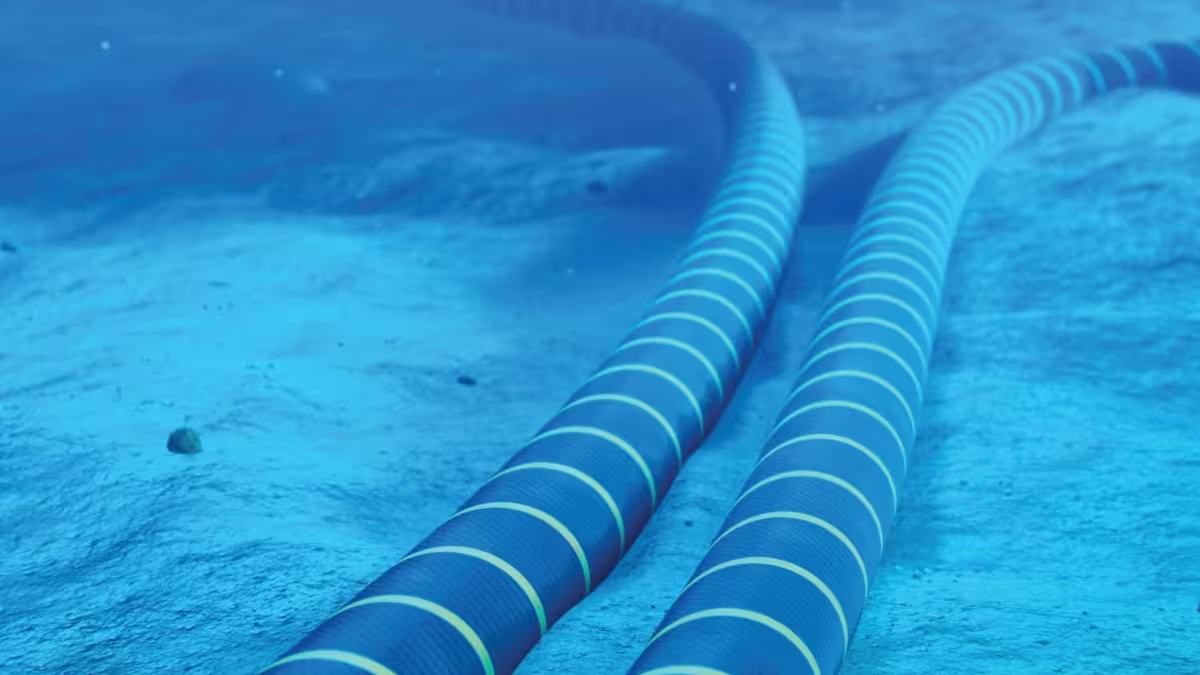
The Iranian media has just put out a chilling warning. And this time it is not about oil. It is not about anchors. It is about the invisible cables that keep the world running. The cables that carry your emails, your bank transactions, your video calls, and 95% of global internet traffic. I’m talking about undersea cables or submarine cables.
The warning came from Tasnim news agency, an Iranian state linked outlet. The message was pointed, stating: “simultaneous damage to several major cables could trigger severe outages across the Persian Gulf.” The report mapped key undersea cables running through the Strait of Hormuz. It made mentions of several Gulf countries, the UAE, Qatar, Bahrain, Kuwait, and Saudi Arabia who rely heavily on these maritime cables. The report framed these landing stations as potential pressure points.
The Invisible Cables That Run the World
Now, let me explain why this deserves your attention. When you send a message to someone, when you transfer money or stream a video on your phone, where does that data go? It flows underwater through the submarine cables. They are laid under the sea on the ocean floor. They use fiber optic light signals to carry global data traffic, which is basically transforming information into light and then sending it through cables. These cables work faster than satellites. They connect continents worldwide and now someone is talking about cutting them.
The Strait of Hormuz: A Digital Choke Point
Let’s talk about why this matters beyond West Asia. The Strait of Hormuz, you know it as the world’s most critical oil choke point. But it is something else too. It’s a digital choke point. It has a dense web of fiber optic cables beneath its waters. They carry an estimated 17 to 30% of regional internet traffic. They power the AI infrastructure hubs of the UAE and Saudi Arabia, the ones backed by tech giants Amazon, Microsoft, and Google.
If these cables snap, and I mean if even some of them snap, the damage won’t stay in the Gulf. Targeting them may result in a wider conflict, dragging in more countries like the EU, the Gulf States. Stock markets could freeze. Banking systems could falter. Payment networks could fail. Within minutes, your entire digital life could be disrupted.
A History of Deep-Sea Disruptions
And this is not theoretical. We’ve seen this before. Undersea cables have been targeted time and again. Back in 2024, NATO reported cable cuts between Finland and Germany and Sweden and Lithuania.
Arjen S. Warnaar, Commodore, Dutch Navy (Tallinn, Estonia – Jan 17, 2025): “Maritime Group One is in the area at the moment to support the new NATO operation Politics Century. As you know, not too long ago, we had a bit of an issue in these waters with critical undersea infrastructure. It is perceived there is a threat to that critical underwater infrastructure and we’re here to help.”
In 2024 and 2025, undersea cables in the Red Sea were damaged amid regional tensions. Internet speeds dropped, services went down, repairs took months because ships couldn’t safely access the area. Yemen’s Houthis rebels have threatened this infrastructure before.
And just recently, the UK defense secretary revealed that three Russian submarines conducted a covert operation around cables and pipelines north of the UK. A British warship and aircraft were deployed.
John Healey, Defence Minister, UK (London – April 9): “In response to the Russian submarines, I can confirm that I deployed our armed forces to track and to deter any malign activity by these vessels. A Royal Navy warship and Royal Air Force P8 aircraft alongside allies ensured that the Russian submarines were monitored 24/7. The Akula submarine subsequently retreated home, having been closely tracked throughout, and we continued to monitor the two GUGI submarines in and around wider UK waters.”
Back then, Moscow was sending a signal. The same kind of signal Iran appears to be sending now. The playbook is the same. Target what you can’t see. Cut what you can’t defend.
The Impact on India
And here’s the part that hits close to home. India. We are one of the world’s largest consumers of data with over 800 million internet users falling just behind China. Our IT sector, digital payments and AI powered economy depend enormously on these very cables. Landing stations in Oman, the UAE and Pakistan are also on the same fragile network. But disruption means slower internet for millions. Unreliable cloud services, broken payment systems, and a direct blow to India’s booming digital economy.
The New Frontline of War
So here’s the uncomfortable truth. Undersea cables are nearly impossible to monitor. They are incredibly hard to protect. And in a region where tensions are already at a boiling point, even accidental damage could trigger consequences.
The sea has always been a stage for power. But it seems the next war won’t just be fought with warships because this seems to be the new front line where wars are quiet, but the consequences allowed. Where a single disruption can echo across continents. And in a world that runs on instant connection, even a few seconds of silence can feel like chaos.