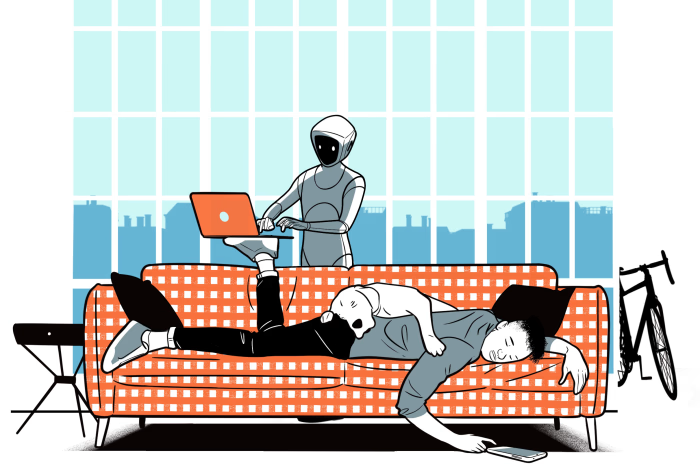
Imagine this. You ask a machine to do one small task. Write an email, fix your grammar, plan your day, or maybe answer a question, and in seconds, it does all of it. Convenient, right? But here’s the bigger question today. If AI is carrying the mental load, what is happening to the human mind?
You see, artificial intelligence is no longer a novelty. It is becoming a daily habit. Students use it for homework. Employees use it for reports. Families use it to plan holidays. And companies use it to save time and increasingly in many cases money. Around 900 million people now use ChatGPT every week. When something becomes that common, its consequences deserve a closer look.
So today, we ask a simple question. Is AI making us less sharp? Well, let me just say it. Is it making us stupid? Researchers say it may be weakening human skills in five ways. And let me walk you through these.
1. AI is Making Us Complacent
AI often speaks in a calm, confident tone even when it is wrong. And that confidence can be misleading. Take this example. Last year, many AI chatbots like ChatGPT called Donald Trump the former US president when he’s the current one. That is not a political error. It is what happens when you stop fact-checking.
2. Outsourcing Memory
A yet to be published study from MIT Media Lab tested 54 adults between 18 and 39. They were split into three groups. One used ChatGPT, one used Google search, one used no digital help. All three groups wrote essays. Researchers tracked their brain activity.
The AI group showed the lowest engagement. Some measures were up to 55% lower than people who relied only on their own thinking. And afterwards, many AI users struggled to recall parts of the essays they had just written. So the assignment was done, but thinking was not. And this has a name: cognitive offloading. It means shifting mental effort onto tools. And it has happened before. Maps changed how we navigate. Phones replaced memorizing numbers. Search engines reduced the need to remember facts. Artificial intelligence may now be doing that to our ability to think.
3. Eroding Judgment
A study from Microsoft and Carnegie Mellon University (CMU) shows that 300 knowledge workers were surveyed. Those who relied more heavily on AI said that they did less critical thinking during tasks. That does not mean that intelligence vanishes. It means unused skills fade. Just like the body, the mind weakens when it is not used.
4. Flattening Originality
In the MIT essay study that we just spoke about, teachers said many AI-assisted essays felt generic, some lacked depth, others felt soulless. So the grammar may be perfect, the structure may be clean, but the human voice has disappeared and that voice is often what people remember.
5. Cognitive Surrender
AI surrender. Researchers at the University of Pennsylvania use a term for it. They call it cognitive surrender. That is when people accept AI answers too quickly with very little scrutiny. They begin to trust the machine more than their own instincts. And here’s a real-world example of where that leads. A multinational medical study found that professionals using an AI tool to screen for colon cancer later performed worse at spotting tumors without it. So, the system helped in the moment, but it took something away in the process.
The Real Threat: Outsourced Thinking
Still, there is an important caveat to this. Most of these findings are short-term. The long-term impact is still unclear. Researchers do not yet know whether people adapt safely or whether these habits become harmful over time.
So this raises the question, is artificial intelligence the enemy? Frankly, no. AI is clearly a part of our present. Hospitals use it to read scans. Businesses use it to cut repetitive work. Students use it for tutoring.
The real answer, as always, is balance. Use AI to generate ideas, then apply your own judgment. Use it to explain concepts, then teach them back to yourself. Use it for a first draft, then rewrite in your own voice. Let it save time and use that time to think because the greatest threat is not a clever machine. It’s a human who has outsourced thinking.