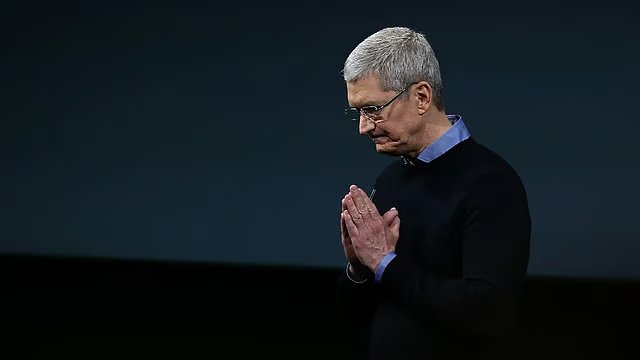
In the end of an era at Apple, after nearly 15 years at the helm, Tim Cook has announced he is stepping down as CEO. But beyond the products, beyond the trillion-dollar milestones, there is another story, one that runs through India.
The Early Days: Potential, Not Priority
When Cook took charge from Steve Jobs in 2011, India wasn’t central to Apple’s plans. In 2012, Cook openly said he loved India but flagged its manufacturing rules as too expensive. For Apple, India was a promise whose potential lay in the future, not a priority ready to deliver quick results.
The 2016 Turning Point
Then came 2016. India had cemented itself as the world’s fastest-growing major economy full of potential of a younger demographic. And then Cook landed in Mumbai, walked into temples, traveled north to watch a cricket match, met business leaders, and sat down with Prime Minister Narendra Modi in New Delhi.
The message was clear: Apple was beginning to look at India differently. Not just as a market, but as a future partner. A year later in 2017, the first iPhone started being assembled in India at a factory in Karnataka by Wistron. Older models, small volumes, but a seed had been planted.
From Sidelines to the Center of the Supply Chain
And then gradually that seed grew, factories expanded, production scaled up, and India began to move from the sidelines to the center of Apple’s global supply chain. Today, that transformation is staggering. India now produces nearly a quarter of the world’s iPhones. From about 1% just a few years ago to billions of dollars in output today, India has become critical to Apple’s manufacturing backbone. This is no longer experimentation. This is dependence.
The Geopolitical Shift and Pushback
And the biggest test of Apple’s India plan came recently. When US tariffs on China surged, Apple needed a backup plan. And Cook had one. The plan was India. He even said most iPhones sold in the United States would now come from India. And to ensure that, he even battled resistance from none other than President Trump.
Donald Trump, President, U.S.: “So they’re going to be building plants here. But I had an understanding with him that he wouldn’t be doing this. He said he’s going to India to build plants. I said that’s okay to go to India, but you’re not going to sell India without tariffs.”
A Retail and Aspirational Milestone
But Cook’s India story isn’t just about factories or geoeconomics for our fast-changing world. It’s also about people, about aspiration. In April 2023, Cook returned to India after 7 years and this time it felt different. Crowds lined up overnight. Fans came from across the country, and then a milestone moment.
The doors opened at Apple’s first official store in India, Apple BKC in Mumbai. Two days later, another opened in Delhi, Apple Saket. Cook called India’s energy incredible, its culture beautiful. And for the first time, Apple didn’t just sell to India. It showed its potential to the world.
The Legacy of Patience
There’s also a market story. India, the world’s second-largest smartphone market, is now one of Apple’s fastest-growing. Billions in sales, rising demand. A young population eager to own a slice of the Apple Dream.
But here’s what makes Apple’s India journey under Cook remarkable. It wasn’t instant. It took over a decade of patience to build. And most recently, it even withstood pressure from Donald Trump.
So as Tim Cook prepares to step aside, his legacy won’t be just about the iPhone or the Apple Watch. It will also be about rewriting Apple’s global map and placing India right at its center.