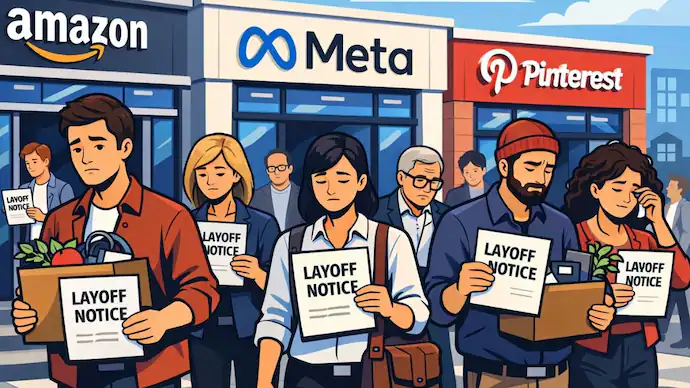
It’s a bloodbath in big tech, and you can blame artificial intelligence for it. Layoffs across the tech industry have accelerated this year. Companies are no longer just cutting costs. They are rewriting how work gets done. Instead of hiring more people, they’re building leaner teams where AI tools do more with fewer humans.
More than 73,000 jobs have been wiped out in the first quarter alone across 95 companies, and the job cuts are far from over. While each company has its own reasons, from cost-cutting to restructuring, there is one common thread: a deeper, more aggressive pivot towards AI.
The Meta Situation
Let’s start with the latest. Meta is preparing for a fresh wave of layoffs with the first round expected around the 20th of May. The company, which owns Facebook & Instagram, plans to cut about 10% of its global workforce. That’s close to 8,000 employees in just the first phase. And more cuts could follow later this year.
Reports suggest executives may even adjust the scale based on how fast AI capabilities evolve. If and when this goes through, it would be Meta’s biggest round of layoffs since its 2022-2023 restructuring. That is when it cut about 21,000 jobs during what it called the “Year of Efficiency.” But this time, the company is financially stronger. So, it’s not about survival. CEO Mark Zuckerberg is investing heavily in AI. He’s building systems that can write code and execute complex tasks autonomously.
The Industry-Wide Pivot
And Meta is not alone. Across big tech, this is the story:
- Snap Inc: The technology company is cutting around a thousand jobs, nearly 16% of its workforce. CEO Evan Spiegel says AI is helping automate repetitive tasks and speed up operations. The company is also eliminating hundreds of unfilled roles, signaling a hiring freeze.
- Amazon: Has already trimmed about 30,000 corporate jobs as it streamlines operations and doubles down on AI.
- Oracle: Founded by Larry Ellison, it has cut between 20,000 to 30,000 jobs as it pours investments into AI infrastructure.
- Crypto.com: The Singapore-based company has laid off 12% of its staff. CEO Kris Marszalek stated these were roles that “do not adapt in our new world.”
- Atlassian: The software company has cut about 1,600 jobs (around 10% of its workforce) to self-fund AI investments. Co-founder Mike Cannon-Brookes says, “People and AI together will drive the best outcomes.”
- Block Inc: The fintech company has also slashed jobs, citing efficiency gains from AI.
And the list goes on. From Salesforce to Pinterest to WiseTech Global, companies are cutting jobs with an aim to redirect the money into AI-driven roles.
The Human Cost and Survivor’s Guilt
Now, this isn’t just a wave of layoffs that we’re talking about. We’re talking about people. People with degrees, with student loans, home loans. They’re all being let go.
And that constant threat of job loss creates a toxic environment. Even if you escape the job cut, you’re left with “survivor’s guilt.” It is the stress felt by employees who keep their jobs. Can you imagine? You watch colleagues around you lose their jobs. That fear of being next. The pressure to do more with less. The constant uncertainty.
It’s now taking a serious toll on mental health. Employee health platforms are reporting a four-fold spike in telehealth consultations for mental health issues. 77% of these cases are from employees aged 21 to 30. Studies also show up to 80% of IT professionals report feeling stressed, and over 70% show symptoms of conditions like depression, insomnia, and anxiety.
The Gen Z Backlash
The shift to AI isn’t just changing how companies operate. It’s changing how employees see themselves. Many now feel their skills are becoming obsolete. And who is most at risk? Young professionals. Early-career employees are facing a loss of confidence and rising anxiety in an increasingly competitive job market.
A 2026 study found that 44% of Gen Z employees admit they’ve actively sabotaged, instead of embracing, the AI initiatives taken by their companies out of fear of losing their jobs.
The Future of Work
This is the new reality of big tech: leaner teams, smarter systems, and harder questions. Because in the end, the future of work will not just be determined by what AI can do. It will be defined by what happens to the people it replaces.
The view from the front lines of AI is sobering. The question now is, can we get the human part right?