In February 2026, the Indian government hosted one of the biggest AI summits in the world. The heads of OpenAI, Google, and Anthropic all flew down. $67.5 billion in investment commitments were announced. But the moment everyone remembers from the summit is the Prime Minister of India putting on a pair of AI smart glasses and speaking in Hindi through a device that understood every word.
These glasses were not made by Google or by Apple. They were made by a 2-year-old Bangalore startup named Sarvam AI, a company that most people hadn’t heard of till that day. If you think Sarvam is India’s OpenAI, then you’re wrong. What Sarvam is trying to do for Indian languages and for the Indian market is something nobody else has cracked. We spent the last few days digging into this, and here are three insights that we discovered.
Why Big Tech is Obsessed with India
Before we get into Sarvam, you need to understand why every big AI company in the world is suddenly obsessed with India. Amazon, Google, and Microsoft have collectively committed over $67 billion here. Stanford’s Global AI Index ranks India third in the world behind only the US and China. Now, why is everyone rushing in? Three reasons:
- 700 million smartphone users.
- Hindi is the third most spoken language in the world.
- India’s middle class is going from 31% to 60% of the population by 2047.
It is a massive market waiting to be served.
The “English First” Problem
But here is the problem that none of these companies have been able to solve. All the large language models out there right now like ChatGPT, Claude, and Gemini, they’re all primarily trained on English data. English is basically their mother tongue. So every time you ask ChatGPT a question in Hindi or even in Hinglish, it first translates it to English, thinks about it in English, and then translates it back to Hindi and gives you the answer. None of these models can actually think in Hindi.
And why does it matter? Because right now there are 81 crore internet users in India, out of which only 9 to 10% understand English. The rest 90% are vernacular language users. Which means 90% of India is not being served properly by any big AI player right now. Recently Sam Altman tweeted that India is the second largest market for OpenAI after America. Now just imagine: if only 10% of India understanding English can make the second largest market for the biggest AI company in the world, imagine the potential of the remaining 90% that’s still untapped. And this is exactly the space Sarvam is building in.
So naturally, the government took notice. In 2024, the government of India launched the India AI Mission (10,000 crores) to build sovereign AI, using the same logic as Aadhaar and UPI. And the first startup they selected to build India’s sovereign AI model was Sarvam, with 246 crore rupees in government funding. This is a national bet.
Insight 1: Building from Scratch for Indian Languages
Let’s get into what they actually built. Sarvam LLM is trained on 22 Indian languages—not translated from English and not retrofitted, but actually built from scratch. Their first model, Sarvam 1, was trained on two trillion tokens of Indian language data. Then came Sarvam 2B, a 2 billion parameter model trained on 4 trillion tokens across 10 Indian languages. And by February 2026, they unveiled Sarvam 30B and Sarvam 105B at the India AI Summit.
But language models are only part of the story. India has an oral culture. Millions of new internet users are more comfortable speaking than typing. So, Sarvam built an ecosystem:
- Shuka: A speech-to-text model that actually understands Indian accents and speech patterns (the first open-source Hindi speech recognition model).
- Bulbull: A text-to-speech system with natural voices in 11 Indian languages, complete with regional accents.
- Sarvam Vision & Duck: For reading documents/OCR in Indian scripts and translation.
- Edge AI & Hardware: They built AI that runs offline on a Nokia feature phone (partnered with Qualcomm and HMD). At the summit, PM Modi watched a user press a button on a feature phone to have a full voice conversation about government schemes in a local language—no internet needed.
- Sarvam Kazi: AI smart glasses made in India, launching mid-2026.
- Indus: India’s ChatGPT equivalent—voice-first, multilingual, with already 50,000+ downloads.
Insight 2: The Architects Behind Sarvam
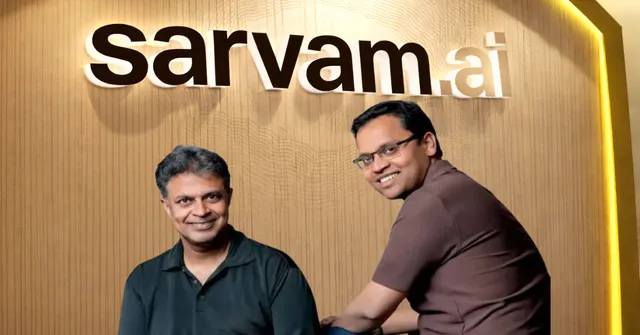
How can a 2-year-old startup pull all of this off? To answer that, you need to know the founders. The AI startup world is full of smart engineers, but what separates Sarvam is the specific background of its two founders:
- Vivek Raghavan: IIIT Delhi, PhD from Carnegie Mellon. He was the chief product manager and biometric architect at UIDAI—the guy who helped build Aadhaar. He has built tech that serves 1.4 billion people. He also advised Bhashini and mentored AI4Bharat at IIT Madras.
- Pratyush Kumar (CEO): IIT Bombay, PhD from ETH Zurich, researcher at IBM and Microsoft Research, faculty at IIT Madras. He co-founded AI4Bharat, which created the largest open-source Indian language datasets in the world.
One founder built Aadhaar at a billion-user scale. Another built India’s language AI from scratch. They spent a decade doing this groundwork before even starting the company. Just four months after founding, they raised $41 million from Lightspeed, Peak XV, and Khosla Ventures.
This allowed them to build a “Full Stack” company. Instead of just wrapping OpenAI’s API, they are building foundational models (like OpenAI), a data intelligence layer (like Palantir), and an implementation layer (like Accenture).
Insight 3: The B2B Monetization Strategy
Building great AI is one thing; making money is a completely different game. Sarvam is not going consumer-first. Their monetization is strictly Enterprise and Government B2B.
- Government: They partnered with UIDAI to deploy AI voice interactions for users to check their status in their own language. Government contracts give them massive credibility.
- Enterprise: SBI Life for multilingual customer engagement, Tata Capital for voice AI in lending, Razorpay for voice commerce, and Bosch for automotive.
- Chanakya: Launched in March 2026, this is a vertical specifically for high-security AI for defense and government clients who can’t put their data on public clouds.
Once enterprises build on your stack, switching costs become massive. It’s the same moat AWS built.
The Bigger Picture: AI for the Global South
A lot of people online question whether Sarvam is really building from scratch or just fine-tuning open-source models. The real question isn’t whether they wrote every line of code; it’s whether they solved a problem nobody else was solving. For Indian languages, voice-first AI, and running models on feature phones, the answer is clearly yes.
One comment online summed it up really well: “Sarvam’s funding is 20 times smaller than US models, and still they made an India-specific model. We lack funding, not talent.” India didn’t wait for Visa; it built UPI. It didn’t wait for foreign ID systems; it built Aadhaar. And now it’s not waiting for OpenAI to solve for Indian languages. India isn’t trying to win the AI race the way America or China is. It’s trying to make AI work in 22 languages on a 2,000 rupee phone for a farmer who’s never Googled anything in his life. And if that works here, it works in the entire Global South. That’s the real game.