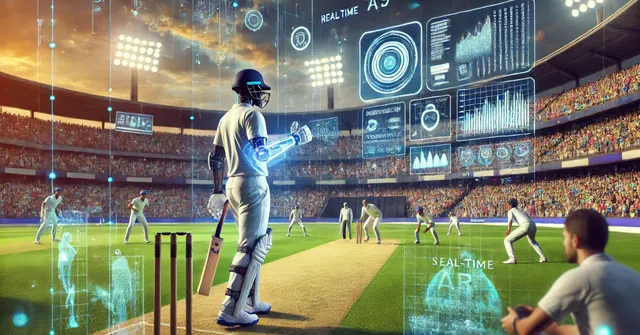
Algorithms over Intuition: The Silent AI Revolution in Modern Cricket – No matter where you are in the world, chances are that you either love cricket or have at least paused once to watch it. Because this isn’t a sport, it’s a shared heartbeat. In India, cricket is nothing short of a religion. And with the Indian Premier League coming back, the next two months aren’t just a season. They’re an obsession. Now, imagine layering that passion with AI where every shot, every strategy, every decision gets smarter. This is where cricket meets its most exciting evolution.
The Era of Pure Human Judgment
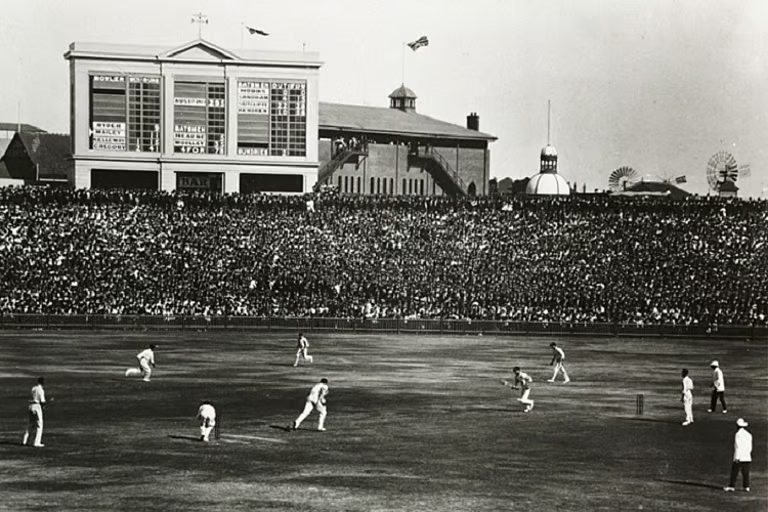
For generations, cricket wasn’t governed by algorithms. It was a game of pure, valuable human judgment. But then this happened. TV cameras showed up. Technology broke through. Now your dad eating chips on the couch knew more than the umpire on the field. It was as if we went from trusting an umpire’s instinct to really making sure that he got it right.
And fast forward to today. We’ve got AI predicting injuries before players feel pain. Robot dogs delivering match balls. And big corporations investing billions of dollars in the game. So the question isn’t whether AI technology makes cricket more accurate. It obviously does. The deeper tension we are exploring is how technology has been rewriting the game of cricket. Are we upgrading the game or are we deleting the imperfect human parts of it that made us feel and care about cricket in the first place?
The Television Revolution and the Legitimacy Crisis
To understand how we got here, you need to see how simple things used to be. In 1744, cricket established its laws. Two umpires decided everything. No appeals, no reviews, no ways to fix mistakes. You had a few thousand people in the stands. Most of them couldn’t even see properly. And in those days, news traveled slow. If you disagreed with an umpire’s call, that debate stayed local, maybe lasted until closing time at the pub, and then everyone moved on.
But that system had a ticking time bomb buried in it. What happens when everyone can prove that the umpire is wrong?
The BBC first broadcasted cricket on June 24, 1938. There were only 7,000 television sets in London at that time. The signal barely reached 20 kilometers. The broadcast was primitive, black and white, no replays, no multiple camera angles, but it established something huge. Cricket could now be witnessed by a mass audience beyond the people physically present at the ground.
As TV improved through the 70s, 80s, and 90s, something shifted. Viewers watching replay footage could instantly spot umpiring errors that live umpires had missed. Clear edges were given not out. LBWs nowhere near the stumps ruled out. Cricket was having its first legitimacy crisis. If everyone can see that you’re wrong, why are we pretending to be right?
The Kerry Packer Disruption
But then Australian billionaire Kerry Packer shows up and accidentally revolutionizes everything. In 1976, Packer offered the Australian Cricket Board $1.5 million for exclusive TV rights. The ICC rejected the offer. Instead, preferred their long-standing relation with the Australian Broadcasting Commission.
Packer did the most aggressive move possible. He literally created his own cricket league out of spite. World Series cricket ran from 1977 to 1979 and it introduced stuff that seemed absolutely insane at that time. Daylight matches with flood lighting, colored kits instead of traditional whites, eight cameras instead of two, on-screen graphics showing real stats. He wasn’t trying to save cricket. He just wanted to make it more entertaining, and it worked.
You had sold out stadiums, huge TV ratings, and suddenly you had traditional cricket that looked boring in comparison. To survive, the ICC adopted, and this is where power shifted from traditional in-stadium viewing to a more digital experience. Cricket went from being just run by cricketing people to now broadcasters.
The Rise of Ball-Tracking and DRS
Then in the mid-90s, the snickometer launched. Sensitive microphones at the stumps could detect that distinctive crack when leather strikes willow. Edges that were completely inaudible to human ears could suddenly be detected and visualized. Then Hawkeye launches in 2001 using 10 high-speed cameras positioned around the stadium to track the ball’s three-dimensional trajectory and predict LBW decisions. Around 2007, hotspot infrared imaging showed up, detecting heat friction when the ball contacts equipment.
So by early 2000s, a structural contradiction had emerged. Television viewers could see what umpires could not. But umpires retained ultimate authority.
However, not all tech implementations were smooth. DRS faced huge challenges in its implementation. Not everyone was on the same page even after it was tried on an English county level. After having dropped off the idea of implementing DRS, a surprising event made everyone turn their head around. In 2007, the Australian Open used a Hawkeye system for players to question the umpire’s decision. Seeing the success of it, the ICC decided to speed up its implementation.
In 2008, India was the first one to test its implementation in an India-Sri Lanka series. However, the experience resulted in long-term reluctance of the use of technology. After years of back and forth, DRS as a technology had changed the course of the game. It improved accuracy. The reduction in clear errors has been substantial. Fans aren’t screaming at their TVs about blatant mistakes anymore.
However, it introduced a new problem: Umpire’s call. If the technology shows the outcome is marginal, the ball hitting the outer 50% of the stump, the on-field decision stands. A batsman could be given out if the ball’s hitting 51% of the stump, but not out if it’s hitting 49%. The difference between out and not out is literally 2% of a stump’s width. Either trust the tech or don’t. The halfway house satisfies nobody.
The Data Explosion and AI Integration
Cricket’s most fundamental principle established in 1744 was that two umpires made final decisions. DRS has undermined that authority and we can’t get it back.
So by the late 2010s, cricket had accumulated terabytes of data. Every DRS review produced video footage, audio data, ball tracking predictions. Teams had data on how individual batsmen performed against specific bowling styles across thousands of matches. Humans can’t process that. A batting coach can observe patterns, but can they quantify this across 500 bowlers, 100 pitch conditions, and various weather patterns? No. But AI can. And that’s where things accelerate.
The first major application of AI in cricket was match prediction. The AI analyzes everything. Head-to-head records, venue-specific data, player form, pitch conditions, weather, even the toss outcomes. But AI isn’t just predicting matches from the couch. It’s inside the game, giving real-time strategic advice. England won its first-ever cricket world cup in 2019 using AI-driven insights for field placements and bowling changes. India and Australia followed.
Perhaps the most beneficial application of AI has been injury prevention. The IPL has pioneered this, substantially reducing bowler injury rates. A company called Zone7 uses machine learning to predict injury risks before symptoms actually even appear. In 2025, Jasprit Bumrah suffered a lower back injury. When Mumbai Indians brought him back for IPL in 2025, they were confident because the data said that he was ready. The AI had monitored his recovery, his training intensity. By April, the algorithm predicted he was safe to play, and he was.
This is genuinely revolutionary for player health. But think about what’s happening here. An algorithm is deciding whether Bumrah plays, not just the physio’s experience, not just Bumrah’s own feeling about his body.
Match Fixing and The Changing Business Landscape
And then there’s match-fixing detection. Sports Radar’s AI system monitors betting behavior across more than 600 betting operators, analyzing over 30 billion odd changes per year. The AI uses statistical anomaly detection to identify suspicious patterns, sudden coordinating betting moments right before a suspicious performance change. Bets that predict unusual outcomes before they even occur.
But AI has also revealed an uncomfortable truth. Corruption in cricket remains substantial. The expansion of illegal online betting, cryptocurrency betting, and unregulated markets has made corruption harder to detect and easier to execute. So AI is catching more fixers than ever before, but it’s also showing us that there are more ways and more fixers than we thought.
Fast forward to August 2025, India dropped a massive bombshell. The government banned all real money fantasy sports to protect people from gambling addiction. Dream 11, which had been Team India’s title sponsor, was suddenly out. The total sponsorship, a staggering 7,000 crore, gone. Cricket had a massive hole in its budget and AI companies were ready.
In January 2026, Google Gemini secured a 270-crore, three-year IPL deal, becoming the first AI platform to ever sponsor the IPL. ChatGPT followed up with a 16-crore WPL partnership. Think about that. ChatGPT’s first sponsorship on the entire planet was Indian women’s cricket. This wasn’t about brand building. This was a land grab. AI companies understood India is number one in Asia Pacific for AI adoption, and when you’ve got 500 million people watching IPL, you’re looking at the largest concentrated AI customer base on earth.
As a result, India has moved from consuming sports tech to actually exporting it. Today, nearly half of all global cricket analytics startups are Indian, an ecosystem fueled by incubators like IIT Madras and legends like Anil Kumble. His venture Spektacom uses a 5-gram sticker to turn a wooden bat into an IoT device, while startups like Str8bat are bringing elite-level metrics to the mass market.
The Final Question: Tech vs. Tradition
As global AI in sports surges towards a $19 billion valuation by 2030, we’ve crossed a threshold. But the question remains, when an umpire makes a bad call, we get angry. But we move on. The controversy becomes part of the story. That’s a conversation that lasts decades.
But when AI makes a call you disagree with, what do you even do? Argue with an algorithm? Fight with math? The controversy dies. The data said X, so Y happened. End of story.
Cricket survived 250 years of being imperfect. The controversies, the debates, the “that was never out” arguments. That’s not a bug. That’s what made cricket interesting. So, will the future of cricket be all technology-driven, or will we still have human imperfection that the game was built on?