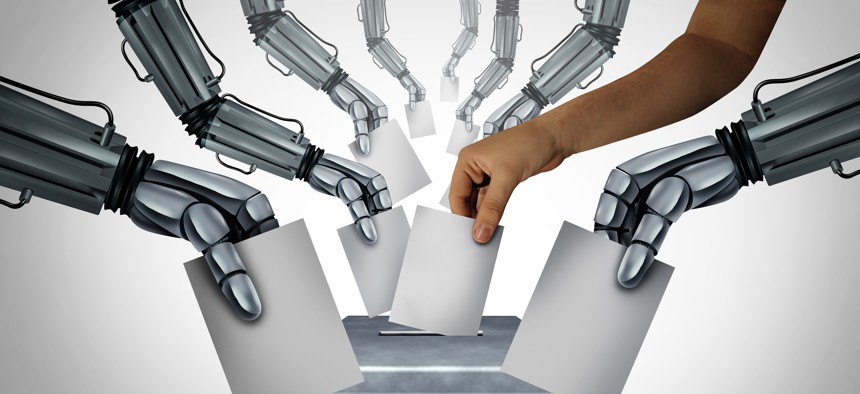
Has Artificial Intelligence Hijacked Democracy: Voting is our democratic right. We believe that our vote must go to those who solve our issues, give us better governance, and ensure that our freedom is not curbed. But what happens if this very right is controlled by artificial intelligence? These are uncertain times we live in. And the question that sits at the crossroads of democracy, technology, and power is this. Can artificial intelligence tell you how to vote? And should it be telling you?
From our phone screen to our social media feed, algorithms already shape what we see, how we feel, and what we believe. But as AI turns more conversational, more persuasive, and dangerously more humanlike, the line between informing voters and influencing voters is now becoming dangerously thin.
The Double-Edged Sword of AI in Elections
AI can serve as a great informative platform where you can get:
- Summaries of long manifestos
- Break down complex issues
- Quick updates on where each candidate stands on various issues
- Policy measures that each party has taken so far
So for a busy voter, that sounds like a perfect gift. Short, crisp summaries of what each party is offering. But it has its downside as well. It can influence your opinion by:
- Giving more positive information about one particular candidate
- Tell you who leads popularity polls
- Explains why one party’s policy worked
- What are the things that go against a party
- And which party is likely to have an edge over others
Prediction vs. Wisdom: The Bias Catch
Now, here’s the catch. AI doesn’t really think, it predicts. It generates responses based on data patterns. And is that data unbiased and complete? Well, not really. It has its own biases, gaps, and sometimes deliberate manipulation because at the end of the day, it is still being fed information at some point.
So, when you ask Chat GPT or Perplexity or Claude, who should I vote for? You’re not getting wisdom. You’re getting a well- constructed answer shaped by training data, design choices, and guardrails set by human beings and humans own AI companies. The risk of a handful of tech CEOs influencing and controlling your decision looks like an extremely concerning situation.
Global Concerns and the Threat of Manipulation
These concerns have been flagged by multiple countries. The head of Brazil’s electoral court, Justice Cármen Lúcia Antunes Rocha said in January this year that chatbots could lead to contamination in the country’s upcoming election. Each time Brazilians asked Gemini and Chat GPT who the best candidate was, the system would give a name when ideally it should leave it to the voter to decide.
Now imagine this at a large scale. Millions of voters asking AI tools for guidance, personalized responses. It raises the big critical question. Who controls AI? Is it neutral? Is it transparent or is it subtly nudging opinions?
Artificial intelligence can simplify complex issues into misleading explanations. and in the wrong hands. It could even become a powerful tool for political manipulation. Much more dangerous, faster, cheaper, and much harder to detect than traditional propaganda. Across the world, governments and regulators are already grappling with this challenge. Some are proposing rules to limit AI generated political content. Others are pushing for transparency. But technology is a fast evolving domain. It doesn’t wait.
The Indian Context: A Balanced Approach
Amid this, Indian democracy has been balancing quietly its tryst with technology smoothly so far. During the recent state elections, if you ask chat GPT who the best candidate is, it would tell you that it cannot decide for you and it’ll give you various promises that each key candidate has done to woo the voters. In the end, it says that it is up to you to decide.
Now, for a country of 1.4 billion people. The views expressed online and AI use is from all ideological sides and not inclined only towards one which lets debates, arguments and representation of each ideology thrive. But globally and in the near future, maybe the question will no longer be if AI influences elections, but how much it already impacts all of us voters.
The Human Choice in Democracy
So, should artificial intelligence tell you how to vote? Well, the answer isn’t a simple yes or no because AI can be a tool and powerful one at that to understanding issues, comparing viewpoints, and becoming a more informed citizen.
But it should never ever replace your judgment. It should never become your conscious. Democracy depends on individual choice. Let it be messy, informed, but deeply human. When that choice is outsourced to algorithms, we risk losing something that no machine can ever give us, our conscious.