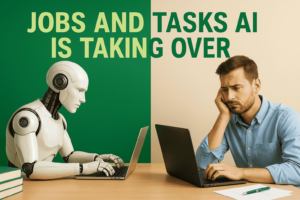
Scrolling, Prompting, Forgetting: The Real Cost of the AI Boom: I have a quick question. When was the last time you trained your brain? Not just your body. Because in 2026, the real crisis may not be what we’re eating, but also what we’re consuming digitally. Now, increasingly, experts are warning that we are losing the ability to think and to think deeply. Not occasionally, not selectively, but systematically.
The Data: Shrinking Attention and Literacy
And this isn’t just a philosophical rant. It’s backed by data. Research reveals that our attention spans today are roughly one-third of what they were in 2004. 1/3. The sharpest decline happened around 2012. Coincidentally, or perhaps not, that’s when smartphones began their global takeover.
The trend doesn’t stop there. Long-term surveys show that the share of adults with low literacy rose from 19% in 2017 to 28% in 2023.
Faster Thumbs, Slower Thinking
Let’s also talk about the most vulnerable group: children. Kids today aren’t just growing up, they are buffering. Example: ask a child to focus for 10 minutes. TikTok has already trained them for 30 seconds.
Another—and perhaps something that is becoming dangerously commonplace—is cognitive offloading. Why think when Google or AI can answer? It is basically a fancy term for putting your brain on the back burner, outsourcing thinking, if you will. Add to that mix lesser real-world interactions and you get weaker memory, poor focus, and shaky critical thinking. In short, faster thumbs, slower thinking.
And the data reflects this shift. The rise in concentration difficulties among teenagers over the past decade aligns almost perfectly with the explosion of smartphones and social media.
The AI Trap and “Cognitive Debt”
Now let’s connect the broader dots. The mid-2010s marked the explosion of the digital attention economy where apps compete quite literally for your brain space. A recent meta-analysis found that short-form video content is linked to poorer cognition and reduced attention span.
Enter the latest disruptor: artificial intelligence. A study from January based on over 600 participants found a significant negative correlation between frequent AI use and critical thinking ability. A 2025 MIT study found that using AI for writing may come with a catch: Cognitive debt.
Around 83% of users could not recall what they had just written. How could they? They’re not really doing the thinking, are they? Brain activity dropped by nearly 55% compared to writing manually even though tasks were completed about 60% faster.
Ultra-Processed Content and “Deep Work”
And yet this crisis feels oddly inevitable. We’re living in an age of ultra-processed content. Think about it. If junk food has chips and soda, digital junk has reels and rage-bait posts.
So, who’s sounding the alarm? Cal Newport, a professor at Georgetown University. The mind behind concepts like deep work and digital minimalism. His argument is simple but radical: In a world of constant distraction, the ability to focus deeply is becoming a rare superpower. Is that the new social currency being offline?
The Global Crackdown
Governments, it seems, are beginning to agree, especially when it comes to protecting children. Australia and Indonesia became the first nations to ban social media for children under 16. And it’s not alone. Countries like Malaysia, Denmark, and Spain are also mulling this move.
Even in India, action is brewing. Karnataka has proposed a ban for children under 16. And Andhra Pradesh is considering restrictions for those under 13.
“It’s clear that this has a significant impact on their development both personally and cognitively as well as on their understanding of the world and their perspective on it.” > — Laure Miller, MP, France
Workplace Distractions
Now, the workplace doesn’t help either. According to Microsoft’s 2025 work trend index, office workers are interrupted every two minutes on an average. Every two minutes. Focus in such an environment never stood a chance.
Social media and constant email barrages weakened our focus. AI made it easier to avoid thinking altogether. And the more we rely on it, the worse our cognitive strength becomes.
The Fix: A Workout Plan for Your Brain
So what’s the fix? Think of it as a workout plan, but for your brain.
- Reading, learning new skills, and keeping your mind engaged are your daily reps.
- Add a dose of aerobics to get the blood and ideas flowing.
- And don’t forget the basics with a healthy lifestyle.
“So brain health is multi-dimensional. there are many beneficial activities that might one might engage in. and cognitive enrichment is one of those activities that complements diet and and physical activity.” > — Andrea Zammit, Neuropsychologist
The digital age has made us faster but a little more distracted too. For children, distraction is now the default.
So here’s the question: In an era of endless scrolling, is picking up a book the ultimate act of defiance?