How Artificial Intelligence Data Centers Are Consuming Our Drinking Water: 1/15 of a teaspoon. That’s how much water the average single interaction with ChatGPT uses, according to Sam Altman, the boss of OpenAI. So if you type, “Can you help me solve this maths problem?” That’s a drop. Or “Can I put lime instead of lemon in this recipe?” That’s a drop. Or “Why is the sky blue?”, “Help me write this email”, “Help me improve my website code.” Mr. Altman claims there are 1 billion messages sent to ChatGPT every day, and ChatGPT is just one AI bot. Chuck in Gemini, DeepSeek, Claude, and others. It’s clear that the AI revolution is a thirsty one. Striking though it is, some experts are more than a little sceptical of Sam Altman’s estimate on water usage.
The Real Cost of a Prompt
“At this point, there was just not enough information for me to agree with or trust the number. Their number was perhaps referring to some tiny models. We’re considering a medium-sized large language model that’s the size of GPT-3. Basically, if you write an email or ask some questions, if you have 10 to 50 queries, you’re going to be consuming roughly 500ml of water.” > — Professor Shaolei Ren, University of California
This calculation includes water used in cooling and electricity generation. It’s clear AI uses a lot of water. But why?
Why Does AI Need So Much Water?
Every time you send a prompt to an AI, it has to run complex calculations to understand and respond. This work is done by the most powerful and specialised computer chips in the world, housed inside enormous data centres. Even before users can send prompts, the training process for the models uses the chips to carry out intense work.
And all that extra power means the hardware can overheat and become damaged if not cooled properly. Most data centres use air cooling systems, which was fine until AI came along.
“But now, because these data centres and the infrastructure that’s going in is so much more energy intensive, there are liquid cooling approaches that are now being implemented.” > — Abhijit Dubey, CEO NTT DATA INC.
The Liquid Cooling Process
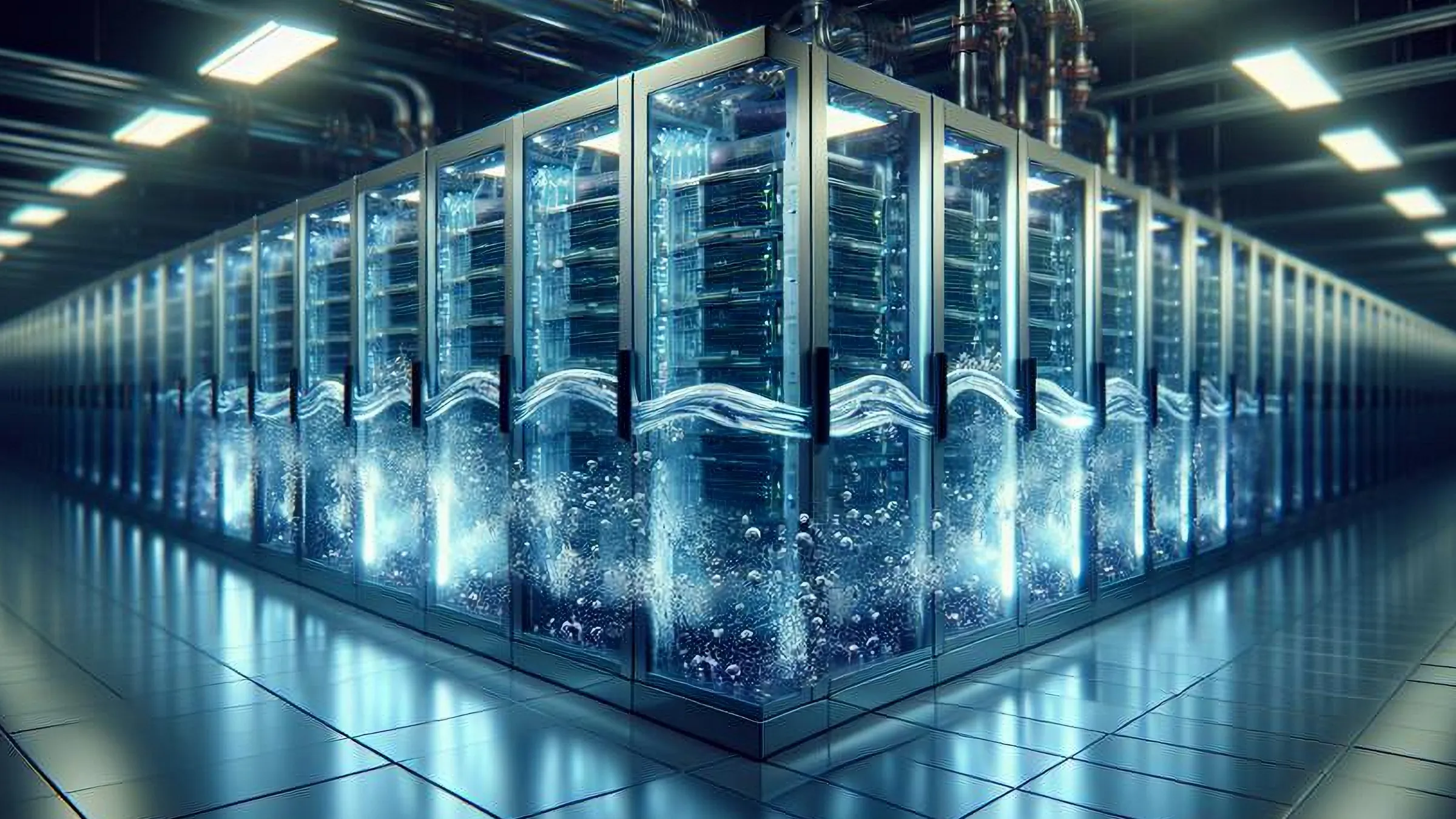
For liquid cooling, the water must be clean to prevent bacteria growing or clogs and corrosion in the system, which means using mostly drinking water. Here’s how the most common liquid cooling process works:
- It begins by piping coolant over the processing chips within the servers.
- This cooling liquid absorbs the heat and takes it away from the electrics to a heat exchange unit.
- Water is used to reduce the temperature of the coolant. The coolant then recirculates back to cool the servers.
- Meanwhile, the now hot water is piped to cooling towers, where a combination of fans and water vapour dissipate the heat, cooling the water.
- Some of the water evaporates in that process, while the rest is recirculated through the cooling process several times before being discharged back into the nearby water source.
Overall, up to 80% of the water evaporates.
“What it means is that this type of water is gone, and that we are extracting water from a water circuit that is necessary for irrigation, for human consumption and hygiene.” > — Lorena Jaume Palasi, Founder of The Ethical Tech Society
Global Protests and Indirect Water Usage
Communities around the world concerned about data centres putting stress on water sources and electricity grids are pushing back. Protests have been held in Spain, India, Chile, Uruguay, and parts of the US.
And it’s not just the operations within the data centre that need water. Generating the electricity to run them requires a lot of water too, because power plants like coal, gas, and nuclear heat water to create steam, which drives a turbine. The International Energy Agency has said electricity demand for AI-optimised data centres is expected to increase by 400% by 2030 to 300 terawatt hours. That’s roughly the electricity consumption of the whole of the UK for a year.
And aside from electricity, water is also needed when manufacturing the semiconductor chips used to run AI.
“So water is both used directly and indirectly in the whole supply and creation chain of AI technologies. It is used for the refination of the critical raw materials that are needed to create the hardware of AI.” > — Lorena Jaume Palasi, Founder of The Ethical Tech Society
Corporate Pledges and Futuristic Solutions
Getting accurate figures on how much water it takes to build AI systems and run them is difficult. Google, Meta, and Microsoft release annual figures showing that their data centres use billions of litres of water every year from local sources, but none of them indicate how much of it is due to AI.
Most tech giants recognise the impact it’s having. Many, including Google, Microsoft, and Meta, have pledged to be water neutral by 2030.
“We hope that can happen, there is a long way to go to get to those kind of numbers. Part of what we hope to see is, across the industry, a range of innovations that allow us to maybe minimise the use of water.” > — Thomas Davin, Director, UNICEF Office of Innovation
Companies are trialing, for example, ways to cool data centres without evaporating any water at all. And to use the heat that’s generated to warm homes. There are also experiments to move data centres away from communities entirely—under the sea, to the Arctic, or even off the planet.
“Can we actually put capacity out in space? It’s very, very early stage. So what, you know, we at NTT are looking at is, can we launch satellites that can at least do some more backup-oriented or other oriented tasks?” > — Abhijit Dubey, CEO NTT DATA INC.
A Sustainable Future?
Though skeptics point to the many hurdles that need to be overcome, there is optimism, too, about a more sustainable future.
“Let’s remember that that GenAI capability is still very, very young. It’s moved exponentially fast, but as an industry and as a use, it is still young. Ideally, we can learn together as a society and as a world society, how do we minimise against the use of water and energy? Because this is all, you know, a world resource when we talk about water.” > — Thomas Davin Director, UNICEF Office of Innovation