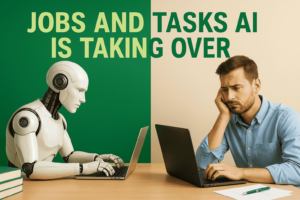
The Impact of AI on Entry-Level Jobs: What You Need to Know: For decades, the deal was simple. You study hard, you get a degree, you land an entry- level job, and you climb up the ranks. That first job you get, the first entry- level job was the bottom rung of the ladder. But now, it turns out that that rung may be disappearing.
And today, we’ll discuss why. Our entry level jobs vanishing slowly. Is AI the villain or is a bigger shift happening in the job market? We’ll discuss all of that and we’ll start with the data. In the United States, entry-level job postings have dropped by 30 to 35%. 30 to 35% drop between 2023 and 2025. Internships are down by 15% in just two years. And that’s not all, report by a venture capital fund called Century Capital. It says hiring of fresh graduates fell by 50% in 2024. That’s 50% down compared to prepandemic levels.
In the US, fresh graduates face higher unemployment than the national average. And this is the first in 45 years. This trend is not unique to the United States. Of course, in India too, tech hiring has dropped by 24%, a 24% drop compared to last year. and active openings are at their lowest level in 6 years.
Entry level IT roles have fallen by 18 to 25%, white collar listings are down by around 20%, especially in roles involving repetitive tasks. And this part is very important. India produces over a million engineering graduates every year. Where do they go if the entry level ramp narrows? And what explains this trend? Why are these vacancies falling? The short answer is two words. Artificial intelligence, AI.
You see, entry- level jobs traditionally involve routine work like data entry, basic coding, drafting reports, customer service calls, Scheduling, or even basic research. AI is doing all of this now. It is faster and cheaper, and it can work 24/7. Of course, companies have noticed this too. So, they are investing heavily in automation. Over 60% of executives say that they plan to use AI to handle entry-level tasks. So yes, AI is absorbing the grunt work.
But this can lead to a major problem because entry-level jobs were not just about getting basic tasks done. They were also training grounds. These roles taught you industry language, business instinct, decision-making under pressure, and office politics. You learned all of it. But if companies stop hiring juniors, how will they groom tomorrow’s leaders? Because employees still need to develop judgment. It’s not something that you can do with prompts. It’s something that comes with experience. The experience of doing the grunt work. Plus, dependence on AI has its own challenges. Three out of four Americans say that they have faced negative consequences because AI got it very, very wrong, 28% say that their work was rejected by stakeholders. 27% say that it led to security issues and 1 in 4 faced customer complaints.
Well, here’s what happened in October last year. Deloitte wrote a report for Australia’s Department of Employment. They used AI to write the report. It contained AI hallucinations. Critics call it work slop. It backfired. Deloitte had to issue a refund. Not too long ago, this kind of work would have been handled by junior consultants, but Deloitte cut those jobs. The number of fresh graduates they hire has gone down by 18%. So, the machine stepped in and we know how it ended.
That is not to say that humans don’t make mistakes, but AI integration has been a mixed bag so far. That’s the point we’re making. Companies are cutting costs by hiring less, but in a few years from now, they may struggle to find leaders.
So if you are a young graduate, what should you do? How do you find your footing in this job market? Well, the first thing you must do is build your skills. You must be useful beyond AI. That means learn the AI tools and learn how to judge this AI output. Quality control will be a massive job category going forward.
The second thing to do is to build a portfolio, not just a resume. Build a portfolio and network aggressively. And third, develop discernment. That’s the ability to decide what is good and what is flawed. The future entry-level job may not be doing the task. It may be supervising the machine that is doing the task.
So yes, entry- level jobs may be vanishing, at least in the traditional form, but the work itself is not going anywhere. And to make the most of it, you must adapt faster than technology does. Because in this new career ladder, the first rung won’t be given to you. You will have to build it yourself.